Yellow Heat Stress Warning Active Amid Record Heat
HK01 · 2 SOURCESabout 1 hour ago6 MIN
Summary
A yellow work heat stress warning was activated at 7 a.m. on Sunday, August 9, as authorities noted elevated heat stress levels in certain work environments . The warning comes amid record-breaking temperatures that have sparked debate over whether the current warning system adequately protects outdoor workers .
Key Points
- The yellow warning, the lowest level in the three-tier system, was issued at 7 a.m. on Sunday, August 9, with authorities urging employers and workers to take appropriate heat prevention measures .
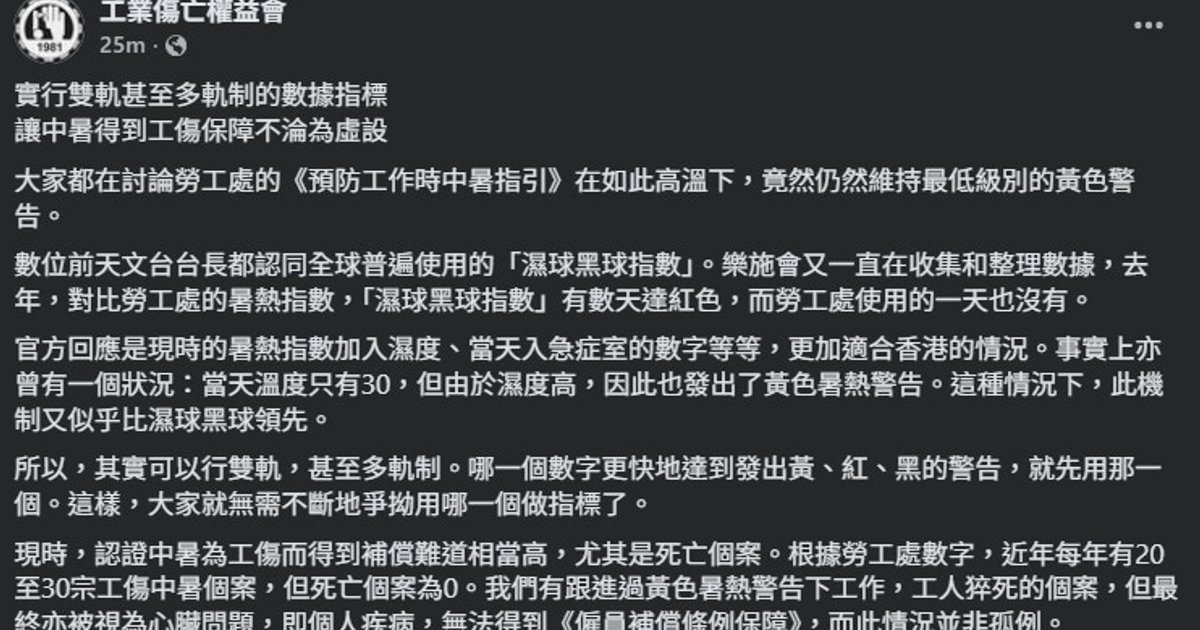
- Siu Sin-man (蕭倩文), general secretary of the Workers' Rights Association (工權會), questioned why the warning remained at yellow despite record-breaking heat, noting the Wet Bulb Globe Temperature index would have triggered red warnings on several days last year when the Labour Department's index did not .
- The Labour Department has defended its current heat stress index, which incorporates humidity and emergency room admission data, arguing it better suits Hong Kong's conditions; Siu acknowledged one instance where a 30°C day with high humidity triggered a yellow warning under the current system .
- Siu proposed implementing a dual-track or multi-track system where any indicator reaching warning thresholds first would trigger the corresponding yellow, red, or black alert, eliminating disputes over which standard to use .
- Certification of heat stroke as a work injury remains extremely difficult, with Labour Department figures showing 20 to 30 annual heat stroke cases but zero fatalities; Siu revealed workers who died during yellow warnings were ultimately classified as heart-related deaths, excluding families from compensation under the Employees' Compensation Ordinance .
- Families seeking justice face the ordeal of requesting autopsies, finding experts to positively assess heat's role in death, and enduring lengthy litigation, often without legal aid funding .
Why It Matters
The gap between warning levels and actual worker fatalities exposes a systemic failure in Hong Kong's occupational heat protection framework. Without reforming the "single causation" test that excludes personal health factors from work injury claims, the legal recognition of heat stroke as a compensable condition remains largely theoretical for bereaved families .
The gap between warning levels and actual worker fatalities exposes a systemic failure in Hong Kong's occupational heat protection framework. Without reforming the "single causation" test that excludes personal health factors from work injury claims, the legal recognition of heat stroke as a compensable condition remains largely theoretical for bereaved families .