Japan Ultra-Luxury Homes Shift to 'Closed Sales' Model Requiring Social Connections
SingTao · 2 SOURCESabout 1 hour ago2 MIN
Summary
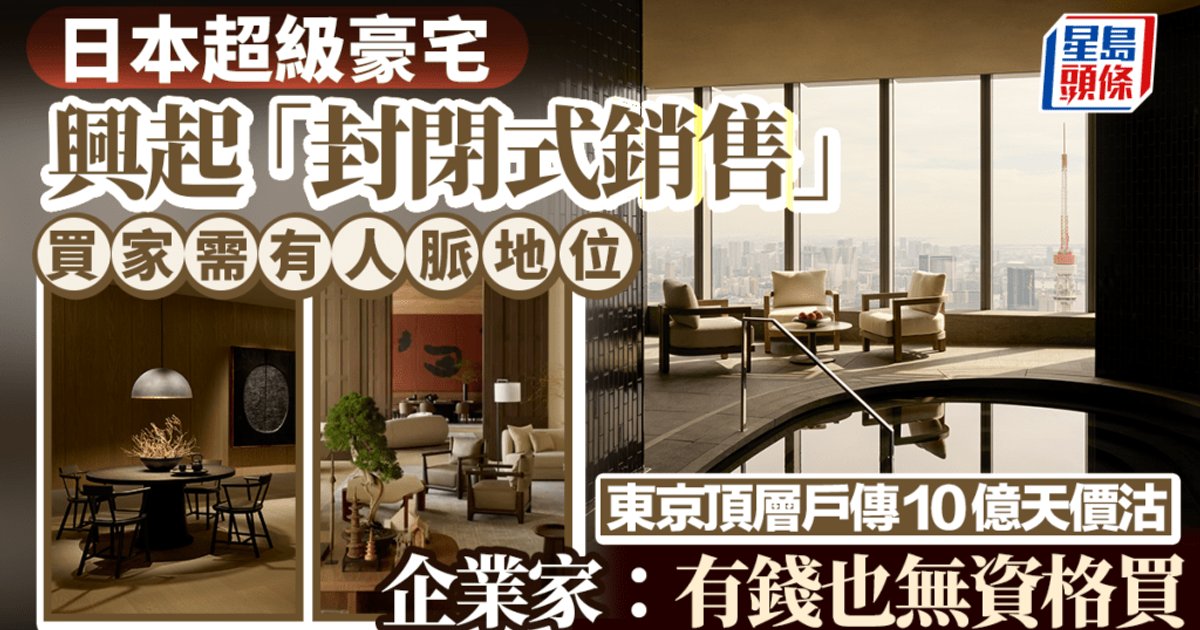
Tokyo's ultra-luxury property market is undergoing a fundamental transformation as high-end developers abandon conventional sales methods in favor of invitation-only, or 'closed sales,' strategies. According to Japanese media reports, this new approach prioritizes a buyer's social network and standing over pure financial capacity. The trend is exemplified by Aman Residences Tokyo, a 91-unit super-luxury residence that has attracted billionaires and celebrities, with its penthouse reportedly fetching nearly 10 billion Hong Kong dollars. Even affluent business owners with tens of billions of yen in assets acknowledge they cannot gain access to such properties without the requisite connections.
Key Points
- Aman Residences Tokyo occupies floors 54-64 of the 330-meter Azabudai Hills Mori JP Tower, offering views of Tokyo Tower with just 91 units and private elevator lobbies
- The penthouse unit reportedly sold for 200 billion yen (approximately 9.87 billion Hong Kong dollars), according to Savills UK
- Residents include startup founders, entertainers, traditional business families, and venture capitalists; some buyers secured financing exceeding 10 billion yen through Swiss financial institutions
- Nomura Real Estate President Matsuo Daisuke explained that when prices reach 500 million yen or 1 billion yen, traditional lottery systems no longer serve wealthy clients who value privacy
- Japan's ultra-high-net-worth population with over 500 million yen in assets reached 118,000 households in 2023, doubling from a decade earlier
Why It Matters
This emerging 'closed sales' model signals a shift in how Japan's ultra-wealthy perceive property ownership as a status symbol requiring social validation, not just financial capability. As Hong Kong and other Asian financial hubs watch Tokyo's luxury market evolve, this exclusivity could further inflate property values for the select few who meet the network criteria, while ordinary high-net-worth individuals find themselves shut out of the market entirely .
This emerging 'closed sales' model signals a shift in how Japan's ultra-wealthy perceive property ownership as a status symbol requiring social validation, not just financial capability. As Hong Kong and other Asian financial hubs watch Tokyo's luxury market evolve, this exclusivity could further inflate property values for the select few who meet the network criteria, while ordinary high-net-worth individuals find themselves shut out of the market entirely .