Saudi-Turkey-Pakistan Sign 'Islamic NATO' Defense Pact
SingTao · 2 SOURCESabout 1 hour ago3 MIN
Summary
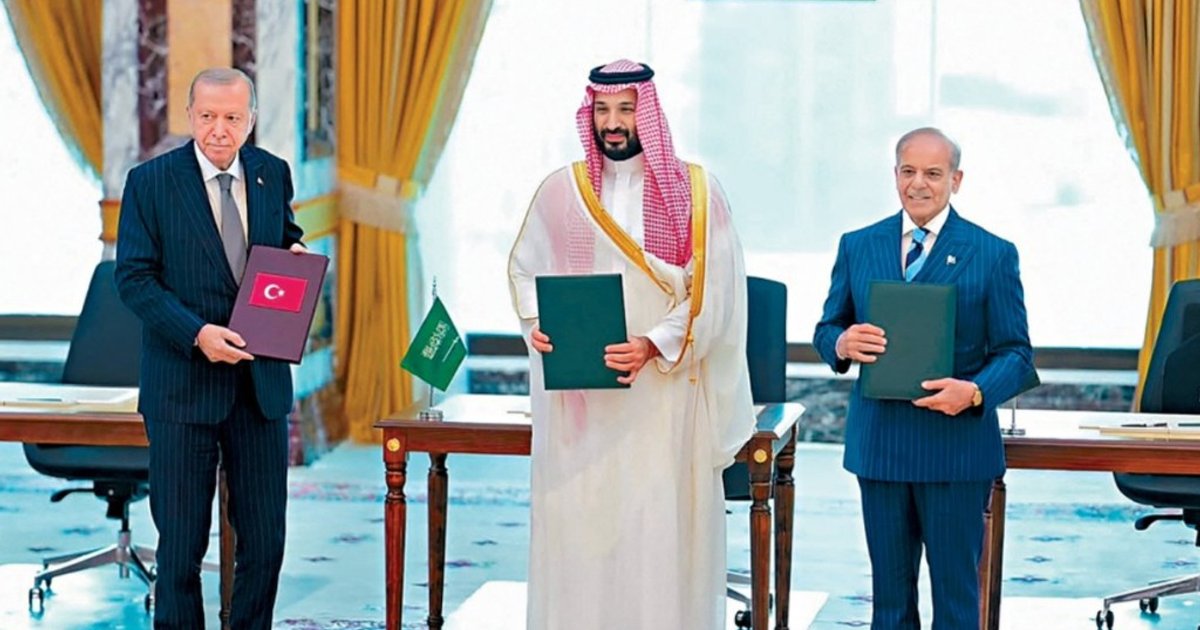
Saudi Crown Prince and Prime Minister Mohammed bin Salman, Turkish President Recep Tayyip Erdogan, and Pakistani Prime Minister Shehbaz Sharif signed the Mecca Mutual Defense Agreement on August 7 in Mecca . The NATO-style pact declares that an armed attack against any of the three nations will be considered an attack against all three, aiming to strengthen joint deterrence against aggression . The agreement marks a significant shift in Middle East security dynamics as these major Islamic powers seek to reduce reliance on external security guarantees .
Key Points
- The Mecca Mutual Defense Agreement was signed on August 7 in Mecca by Saudi Crown Prince Mohammed bin Salman, Turkish President Erdogan, and Pakistani Prime Minister Shehbaz Sharif .
- The pact's core clause states that an armed attack on any one of the three countries will be treated as an attack on all three, mirroring NATO's Article 5 collective defense principle .
- The agreement builds upon a September 2025 bilateral Strategic Defense Agreement between Saudi Arabia and Pakistan, which has now been expanded to include Turkey .
- Pakistani officials stated the agreement is not directed at any specific country but aims to enhance regional stability and reduce dependence on external powers for security .
- Indian media have described the trilateral pact as an "Islamic NATO," expressing concern that it could bolster Pakistan's military capabilities through Turkish technology and Saudi investment .
- Iranian parliament member Rezaie warned that the agreement would not bring security to Saudi Arabia, comparing it to years of unilateral reliance on the United States that failed to provide safety .
- Saudi political analyst Hisham Al-Ghannam said the agreement aims to contain Iran's maritime influence and proxy networks, and prevent a post-war regional system centered on Israel .
- Multiple US media reports have disclosed ammunition shortages in the American military, with high-precision long-range missiles and interceptor stocks for THAAD and Patriot systems severely depleted since strikes against Iran began in late February .
- Reuters analysis noted that sustained Middle East conflicts have not only endangered Saudi oil exports and development plans but also seriously undermined confidence in the long-standing US security umbrella .
- The three nations bring complementary strengths: Saudi Arabia offers financial resources and regional influence, Turkey provides advanced military technology especially drones, and Pakistan contributes nuclear deterrence and battle-tested armed forces .
Why It Matters
The emergence of this independent Islamic security architecture signals a fundamental realignment in Gulf security dynamics that could affect global energy markets and shipping routes vital to Hong Kong's trade-dependent economy . With the United States increasingly perceived as an unreliable partner due to depleted military stocks and inconsistent commitments, regional powers are taking security into their own hands, potentially creating new power centers that reshape how Hong Kong businesses navigate Middle East geopolitical risks .
The emergence of this independent Islamic security architecture signals a fundamental realignment in Gulf security dynamics that could affect global energy markets and shipping routes vital to Hong Kong's trade-dependent economy . With the United States increasingly perceived as an unreliable partner due to depleted military stocks and inconsistent commitments, regional powers are taking security into their own hands, potentially creating new power centers that reshape how Hong Kong businesses navigate Middle East geopolitical risks .