CUHK Introduces Orthopedic Robot System, Completes HK's First Minimally Invasive Pelvic Surgery
On.cc · 1 SOURCESabout 1 hour ago2 MIN
Summary
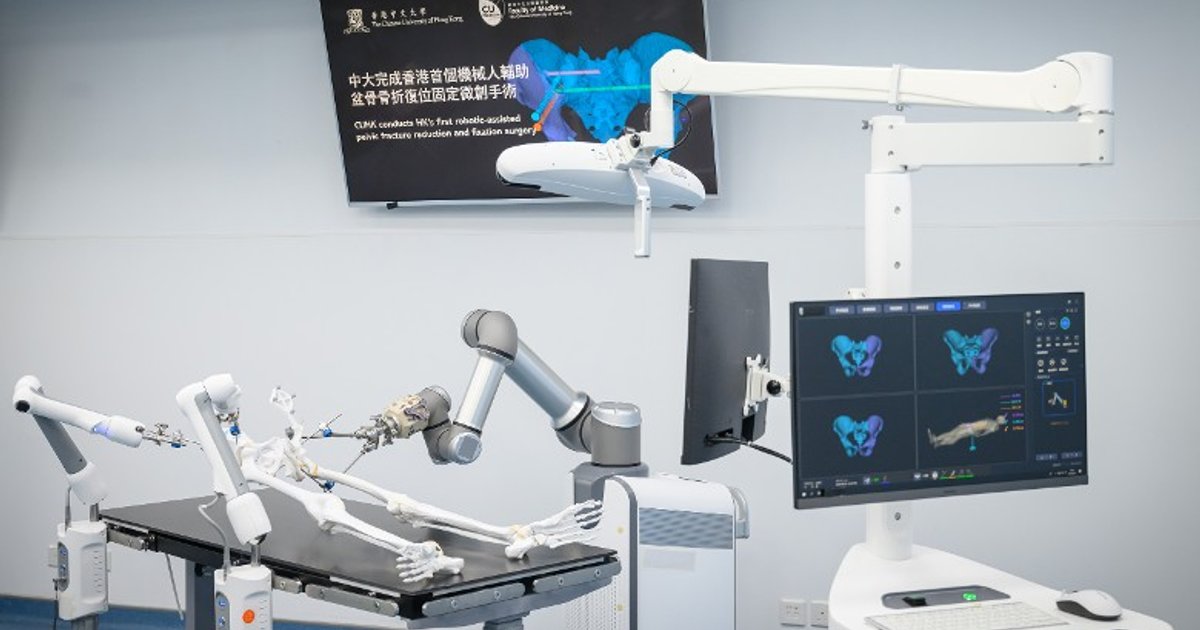
The Chinese University of Hong Kong has introduced an innovative orthopedic robotic surgery system, successfully completing Hong Kong's first robot-assisted pelvic fracture reduction and fixation procedures at Prince of Wales Hospital since June. The new technology dramatically reduces surgical trauma, cutting blood loss by nearly 90 percent compared to traditional open surgery. Clinical Associate Professor Wong Man-young highlighted that this breakthrough offers high-risk elderly patients a safer, more effective treatment option, marking a major advancement in orthopedic trauma care.
Key Points
- CUHK's orthopedic team has performed three robot-assisted pelvic fracture fixation surgeries at Prince of Wales Hospital since June 2024
- The system uses 3D CT scanning for pre-operative planning and real-time three-dimensional navigation during surgery
- Blood loss during robotic surgery is only 10 to 20 milliliters, compared to approximately one liter in traditional open surgery—a reduction of nearly 90 percent
- Surgical incisions have been reduced from over 10 centimeters to less than 2 centimeters, significantly lowering pain and infection risk
- The robotic system has received certification from China's National Medical Products Administration and is listed under Hong Kong's medical device management framework
- CUHK estimates approximately 2,000 pelvic fragility fractures occur annually in Hong Kong, with a one-year mortality rate of 15 percent
Why It Matters
With Hong Kong's aging population, pelvic fragility fractures pose an increasing threat to elderly patients who often cannot tolerate traditional open surgery due to massive blood loss and soft tissue complications. This new minimally invasive robotic approach provides a safe surgical option for high-risk elderly patients, potentially reducing the current 15 percent one-year mortality rate and improving quality of life for thousands of patients annually .
With Hong Kong's aging population, pelvic fragility fractures pose an increasing threat to elderly patients who often cannot tolerate traditional open surgery due to massive blood loss and soft tissue complications. This new minimally invasive robotic approach provides a safe surgical option for high-risk elderly patients, potentially reducing the current 15 percent one-year mortality rate and improving quality of life for thousands of patients annually .