Three Scientists Honored with 2026 Future Science Prize for Breakthrough Research
Bastillepost · 2 SOURCESabout 1 hour ago2 MIN
Summary
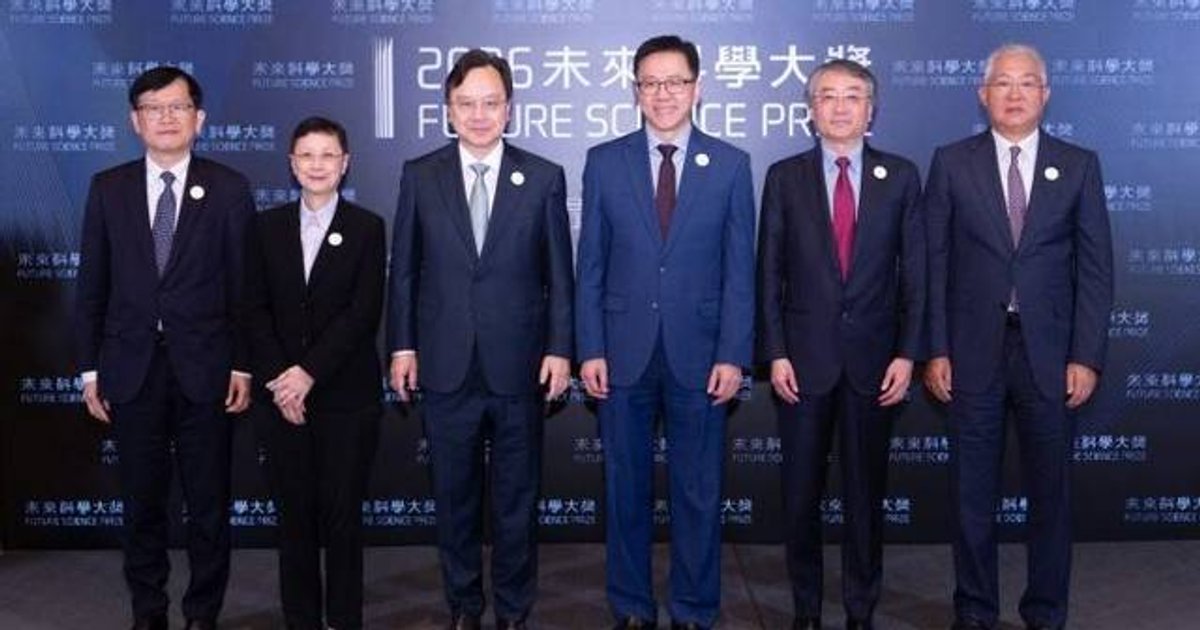
The 2026 Future Science Prize winners were announced on August 13 in Beijing and Hong Kong via simultaneous video link, with three mainland Chinese scientists honored for groundbreaking achievements in their respective fields. Known as "China's Nobel Prize," the Future Science Prize has recognized 49 exceptional scientists over 11 years. The three 2026 laureates—Zhang Hong for life sciences, Zhao Dongyuan for materials science, and Yuan Xinyi for mathematics and computer science—will be celebrated at the award ceremony in November, continuing the event's tradition of bridging mainland research excellence with Hong Kong's international platform.
Key Points
- Zhang Hong from the Chinese Academy of Sciences won the Life Sciences Award for discovering autophagy mechanisms in multicellular organisms, published in Cell in 2010
- Zhao Dongyuan of Fudan University received the Materials Science Award for pioneering ordered mesoporous materials through molecular self-assembly methods
- Yuan Xinyi from Peking University earned the Mathematics and Computer Science Award for founding the arithmetic large volume theory in Arakelov geometry
- The prize has awarded USD 1 million per category to 49 scientists since its 2016 founding, including renowned figures like Lo Yuk-ming and Yuan Longping
- The award ceremony will be held at the East Kowloon Cultural Centre on November 8, 2026, as part of a four-day prize week
Why It Matters
The Future Science Prize continues to elevate Hong Kong's status as an international scientific hub, with this year's event hosting Nobel laureates and featuring exhibitions at the Hong Kong Science Museum to engage the public . The recognition of these three scientists underscores mainland China's growing influence in fundamental research while reinforcing Hong Kong's role in connecting Chinese innovation with the global academic community .
The Future Science Prize continues to elevate Hong Kong's status as an international scientific hub, with this year's event hosting Nobel laureates and featuring exhibitions at the Hong Kong Science Museum to engage the public . The recognition of these three scientists underscores mainland China's growing influence in fundamental research while reinforcing Hong Kong's role in connecting Chinese innovation with the global academic community .