MTR Bans Robotic Dogs After Passenger Incident, Industry Calls for Legislation
SingTao · 1 SOURCESabout 1 hour ago2 MIN
Summary
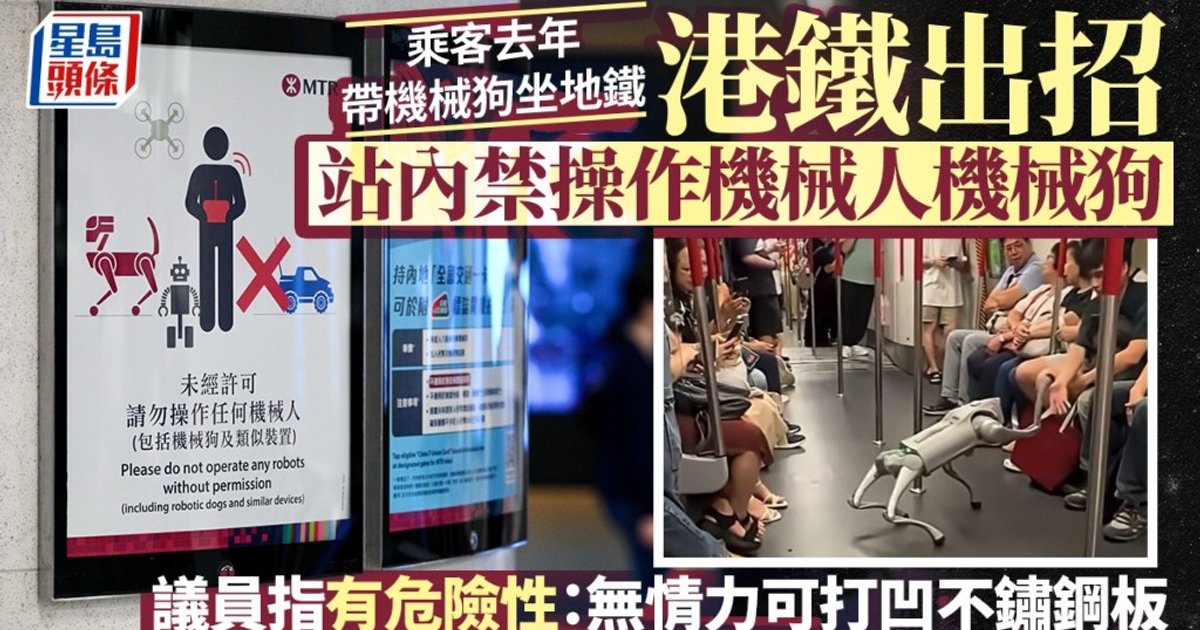
The MTR Corporation has recently posted notices at stations banning passengers from operating robots and robotic dogs without permission . This action follows an incident last year when a passenger was filmed controlling a robotic dog on platforms and trains at Jordan and Cheung Sha Wan stations, performing walking and jumping movements that startled other passengers . Technology industry leaders and Legislative Council members are urging the government to establish legislation regulating the use of robots in public spaces, citing potential safety hazards . The MTR has stated that staff will advise passengers to stop such behaviour and issue warnings if necessary .
Key Points
- Last June, netizens captured footage of a passenger operating a robotic dog on MTR platforms at Jordan and Cheung Sha Wan stations, performing various movements that frightened other passengers
- The MTR notice displays illustrations of robots, robotic dogs, drones, and remote-controlled vehicles, explicitly prohibiting their operation without permission
- Hong Kong Information Technology Association Honorary President Francis Fong Po-kyu warned that robotic dogs have significant force capable of denting stainless steel, and drones could interfere with cables and paralyse the railway
- Legislative Council member Edwin Wong Wai-wai, a member of the AI and Robotics Technology Development Subcommittee, stated that even lightweight robots pose dangers as they could injure passengers if they lose balance and fall
- Both experts recommend the government enact legislation similar to existing drone regulations, with Wong adding that safety improvements in sensors and anti-interference technology should be prerequisites for any future relaxation of restrictions
Why It Matters
As Hong Kong positions itself as a smart city embracing technological innovation, the incident highlights the urgent need to balance technological advancement with public safety in crowded transportation environments . The MTR's proactive approach may set a precedent for other public facilities, signalling that regulatory frameworks for emerging technologies must evolve rapidly to keep pace with technological proliferation .
As Hong Kong positions itself as a smart city embracing technological innovation, the incident highlights the urgent need to balance technological advancement with public safety in crowded transportation environments . The MTR's proactive approach may set a precedent for other public facilities, signalling that regulatory frameworks for emerging technologies must evolve rapidly to keep pace with technological proliferation .