Myasthenia Gravis Association Urges Government to List New Drugs After Survey Reveals Treatment Gaps
On.cc · 1 SOURCESabout 1 hour ago5 MIN
Summary
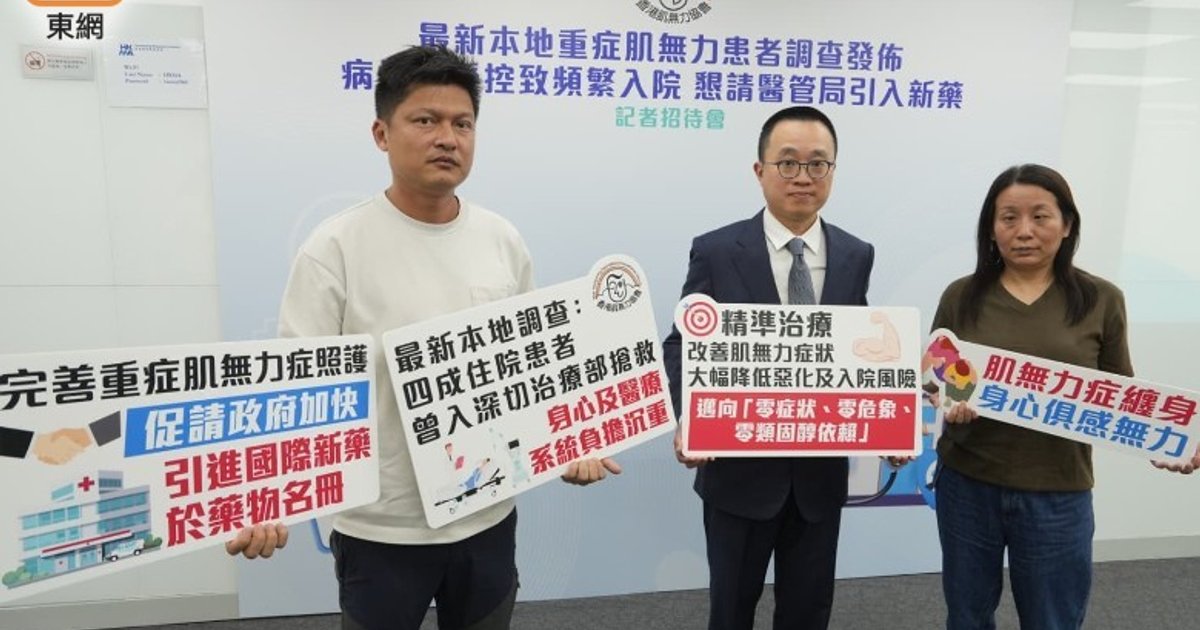
The Hong Kong Myasthenia Gravis Association released survey findings on December 17 revealing that nearly half of patients developed symptoms before age 40, with almost 40% of hospitalized patients requiring intensive care unit (ICU) admission. The association is urging the government and Hospital Authority to expedite approval and inclusion of new biological drugs in the formulary, as current treatments leave over 60% of patients still suffering from symptom折磨 and the new C5 complement inhibitors demonstrate a 79% reduction in disease progression risk. With treatment costs reaching seven figures per course, the association warns that patients are being forced to abandon therapy due to financial barriers.
Key Points
- Myasthenia gravis is a rare chronic autoimmune disease affecting an estimated 1,500 patients in Hong Kong, with no cure or prevention currently available
- Nearly half of surveyed patients developed symptoms during their prime years before age 40, and over 20% required emergency room visits
- Approximately 75% of patients have generalized myasthenia gravis, with symptoms including drooping eyelids, double vision, difficulty swallowing, and limb weakness
- Traditional treatments relying on high-dose steroids carry serious side effects including osteoporosis, metabolic disorders, and increased infection risk
- New C5 complement inhibitor biological drugs can reduce disease progression risk by 79%, with approximately one-third of patients achieving near-complete symptom resolution
Why It Matters
The survey findings underscore a critical gap in Hong Kong's rare disease policy, where effective treatments remain inaccessible due to prohibitive costs. As the population ages, the burden on healthcare resources from preventable myasthenic crises—requiring emergency interventions and ICU admissions—will likely increase. Accelerating drug approval and providing subsidy schemes would not only improve patient quality of life but potentially reduce long-term healthcare expenditure associated with crisis management .
The survey findings underscore a critical gap in Hong Kong's rare disease policy, where effective treatments remain inaccessible due to prohibitive costs. As the population ages, the burden on healthcare resources from preventable myasthenic crises—requiring emergency interventions and ICU admissions—will likely increase. Accelerating drug approval and providing subsidy schemes would not only improve patient quality of life but potentially reduce long-term healthcare expenditure associated with crisis management .