Hong Kong Sports Industry Contributes HK$700B to Economy, Employs 84,000 in 2024
AM730 · 1 SOURCESabout 1 hour ago2 MIN
Summary
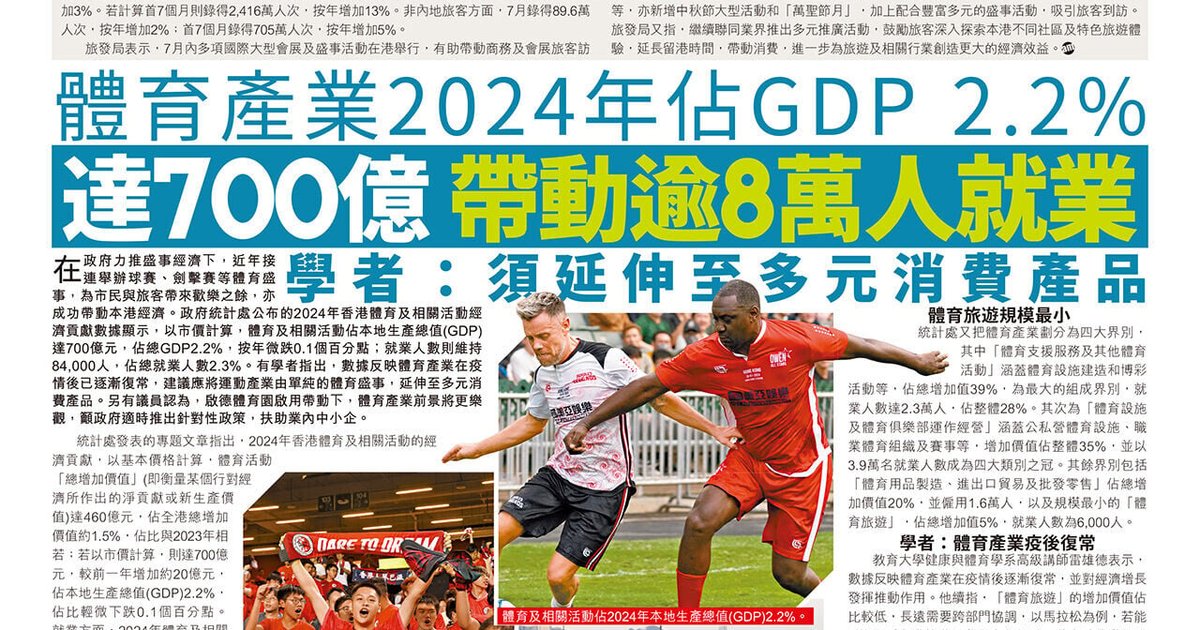
The 2024 Hong Kong Sports and Related Activities Economic Contribution data, released by the Census and Statistics Department, reveals that the sports sector contributed HK$700 billion at market prices, comprising 2.2 percent of total GDP, a slight decline of 0.1 percentage points year-on-year. Employment remained steady at about 84,000 people, accounting for 2.3 percent of the total workforce. Experts suggest the industry should expand beyond sports events into broader consumer markets.
Key Points
- Sports and related activities generated HK$700 billion in economic output, representing 2.2 percent of Hong Kong's GDP in 2024
- Gross Value Added at basic prices reached HK$460 billion, accounting for 1.5 percent of total value added, with employment steady at 84,000 workers
- The sector is divided into four categories: sports facilities and clubs (35% of GVA, 39,000 employees), sports support services (39% of GVA, 23,000), sports goods (20% of GVA, 16,000), and sports tourism (5% of GVA, 6,000)
- EdUHK senior lecturer Lei Xiongde stated the data shows the sports industry has gradually normalized post-pandemic and requires cross-departmental coordination to develop sports tourism effectively
- HKBU Professor Liu Yongsong recommended extending sports beyond events into hotels, retail, and dining, while expanding into Greater Bay Area markets
Why It Matters
The sports industry's steady contribution to Hong Kong's economy demonstrates its resilience following the pandemic recovery. As the Kai Tak Sports Park becomes operational, the sector is positioned to host more international events and stimulate associated industries. Policymakers now face the challenge of providing targeted support for SMEs within the sports ecosystem to fully capitalize on emerging opportunities.
The sports industry's steady contribution to Hong Kong's economy demonstrates its resilience following the pandemic recovery. As the Kai Tak Sports Park becomes operational, the sector is positioned to host more international events and stimulate associated industries. Policymakers now face the challenge of providing targeted support for SMEs within the sports ecosystem to fully capitalize on emerging opportunities.