Rooftop Hut Memories Redefine 'Family' as Retired Teacher Recalls Supporting Five Students on Half His Salary
Bastillepost · 1 SOURCESabout 1 hour ago2 MIN
Summary
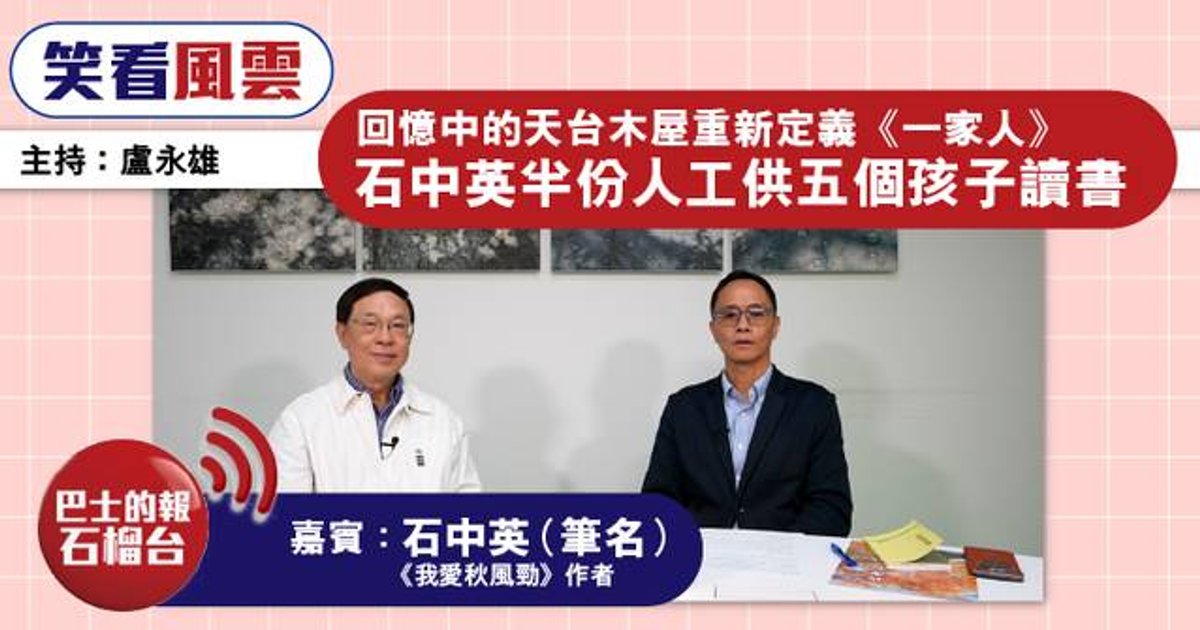
Hong Kong educator Shi Zhongying, whose birth name is Yang Xiangjie, shared in an interview with Lo Wing-hung, president of Bastille Post, the touching story behind his essay 'One Family' from the collection 'I Love the Autumn Wind,' now celebrating its 50th anniversary . During the 1960s and 1970s—a period of economic takeoff yet widespread hardship—Shi taught at a school near the Wan Chai Police Station, where he learned that one of his students had lost both parents and was living in a rooftop wooden hut with three siblings . Instead of spending Lunar New Year's Eve with his elderly mother, Shi chose to accompany these four unrelated orphans, sharing a simple warm meal by a small stove in the leaky iron-sheeted dwelling .
Key Points
- Shi Zhongying, a teacher in 1970s Hong Kong, learned his student—third daughter in an orphaned family—needed help when her parents passed away
- He spent Chinese New Year's Eve with four unrelated children in a leaking tin-roof hut built illegally atop an old three-story building on Cochrane Street, Wan Chai
- At the time, such rooftop structures had iron-sheet roofs that leaked in rain, with 'bathtubs' being plastic basins placed under eaves for children to bathe
- Shi gave approximately half his monthly salary—350 out of 700-plus Hong Kong dollars—to support five impoverished students through secondary school graduation
- When the third sister gained admission to a church school but could not afford tuition, Shi paid immediately, declaring: 'Don't drop out. I'll cover it'
- Lo Wing-hung, reflecting on the story, noted that despite today's wealth, social relationships have become far more indifferent than in that poverty-stricken era
- After the Wenchuan earthquake, Shi donated to rebuild Beichuan Middle School and established scholarships, continuing his tradition of helping others
Why It Matters
This narrative offers a window into Hong Kong's social history, documenting how ordinary citizens practiced the Confucian ideal of 'extending care from one's own elders and children to others' during an era of scarcity . As housing costs and inequality continue to challenge Hong Kong's poor today, Shi's story resonates as a reminder that community solidarity—rather than mere government intervention—once sustained vulnerable families through desperate times.
This narrative offers a window into Hong Kong's social history, documenting how ordinary citizens practiced the Confucian ideal of 'extending care from one's own elders and children to others' during an era of scarcity . As housing costs and inequality continue to challenge Hong Kong's poor today, Shi's story resonates as a reminder that community solidarity—rather than mere government intervention—once sustained vulnerable families through desperate times.