Secondary School Students Develop Affordable Assistive Devices for Visually and Hearing Impaired
AM730 · 1 SOURCESabout 2 hours ago6 MIN
Summary
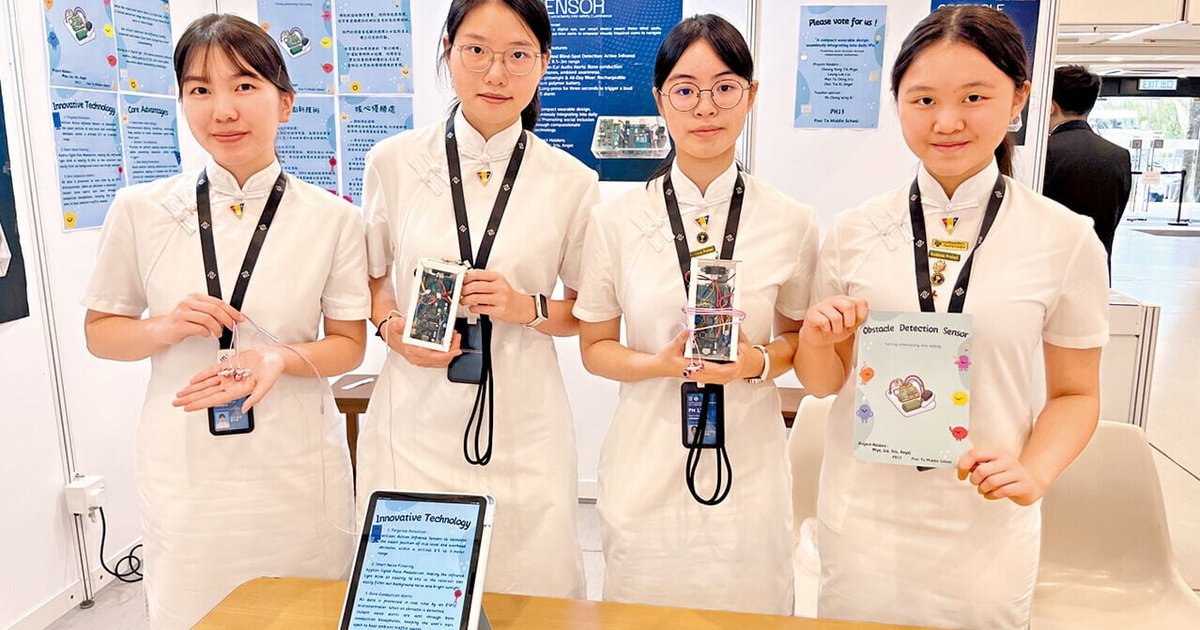
Two secondary school teams participating in the 59th Joint School Science Exhibition have developed innovative low-cost assistive technology devices to address safety concerns for visually impaired and hearing impaired individuals in Hong Kong. The Po Toi Middle School team created a wearable obstacle detection system costing approximately HK$350, while the Belilios Public School team developed smart glasses with AI-powered sound recognition priced around HK$400. Both projects aim to fill accessibility gaps that existing market products fail to address due to their prohibitive costs. The exhibition runs from August 18 to 24 at the Hong Kong Central Library Exhibition Hall, featuring 22 participating schools.
Key Points
- Po Toi Middle School's 4-member team invented a neck-worn obstacle detection device with infrared sensors capable of identifying chest-height hazards within 1.5 meters .
- The wearable system utilizes bone conduction headphones to alert users of obstacles while preserving their ability to hear ambient environmental sounds for safety .
- Team member Man Yu-ching stated that similar commercial products are prohibitively expensive, and their team managed to keep production costs at HK$350 .
- Belilios Public School's team created "聲耀" (Sheng Yao) smart glasses with microphones and AI microchips that trigger LED warnings upon detecting sounds like car horns or fire alarms .
- Team member Zhou Chu-yo explained that traditional hearing aids and bone conduction implant surgeries are costly, making affordable solutions essential for hearing impaired individuals .
- Both student teams had no prior coding experience and relied on manufacturer-provided code, self-study, and AI assistance to complete their projects .
Why It Matters
These innovations directly address critical safety gaps that existing assistive technologies fail to cover. The high cost of commercial assistive devices has historically limited accessibility for low-income individuals with disabilities in Hong Kong, leaving vulnerable populations without adequate protection. By demonstrating that effective safety solutions can be produced at a fraction of market prices, these student inventions challenge the status quo of the assistive technology industry and set a precedent for inclusive innovation in the city.
These innovations directly address critical safety gaps that existing assistive technologies fail to cover. The high cost of commercial assistive devices has historically limited accessibility for low-income individuals with disabilities in Hong Kong, leaving vulnerable populations without adequate protection. By demonstrating that effective safety solutions can be produced at a fraction of market prices, these student inventions challenge the status quo of the assistive technology industry and set a precedent for inclusive innovation in the city.