CUHK Study Finds Capillaries Can Transform Into Arteries to Repair Damaged Hearts
Thestandard · 1 SOURCESabout 1 hour ago2 MIN
Summary
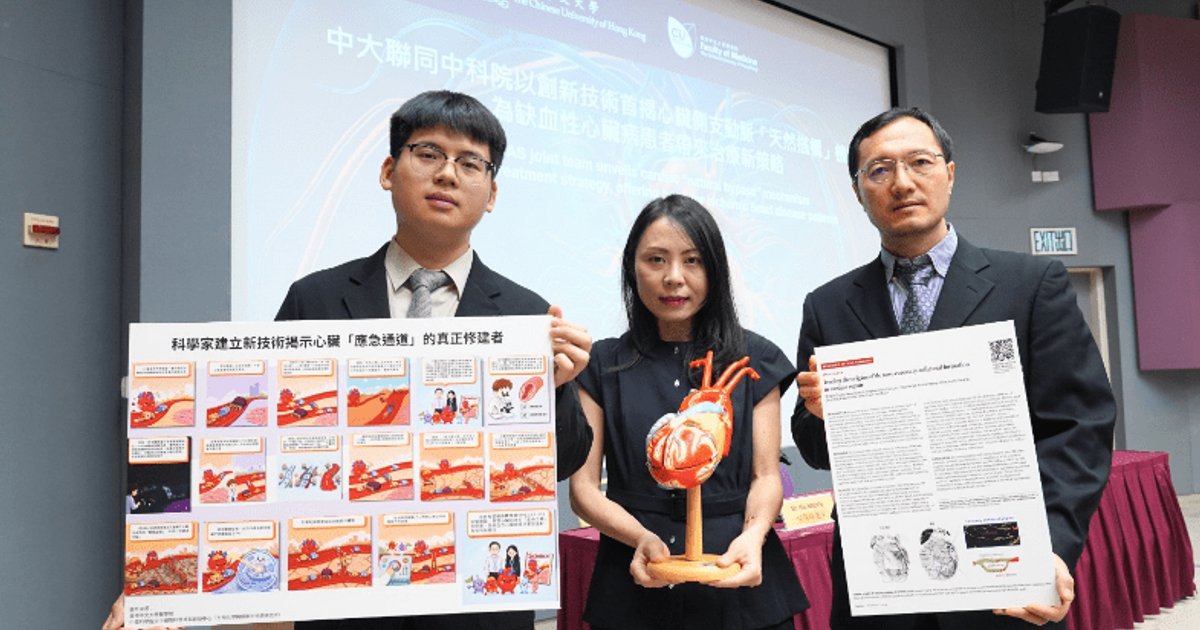
A joint research team from the Chinese University of Hong Kong and the Chinese Academy of Sciences has made a groundbreaking discovery that could transform treatment for heart disease. The researchers found that capillaries, the smallest blood vessels in the body, can transform into coronary collateral arteries after a heart injury, providing a natural bypass system to restore blood supply to damaged heart muscle. This finding challenges previous assumptions about how the heart repairs itself and opens the door to less invasive treatment options for patients with ischemic heart disease.
Key Points
- Capillary endothelial cells, not cells from existing arteries, are the main source of newly formed collateral arteries following myocardial infarction
- Coronary collateral arteries act as natural bypass vessels, creating alternative pathways around blocked vessels to restore blood flow to ischemic heart tissue
- Vascular endothelial growth factor A (VEGF-A) activates a molecular pathway involving transcription factor YY1, prompting capillaries to acquire arterial characteristics
- Transient delivery of VEGF-A through modified messenger RNA (modRNA) significantly promoted collateral artery formation and improved cardiac repair in animal models
- When researchers selectively removed capillary-derived arteries in mouse models, myocardial fibrosis increased and infarct areas became larger
Why It Matters
This discovery provides a foundation for developing less invasive treatments that harness the heart's innate capacity to regenerate blood vessels, potentially benefiting the millions of patients worldwide who suffer from ischemic heart disease . While conventional treatments like coronary stenting and bypass surgery carry risks and are not suitable for all patients, this new approach could offer a gentler alternative that works with the body's own repair mechanisms .
This discovery provides a foundation for developing less invasive treatments that harness the heart's innate capacity to regenerate blood vessels, potentially benefiting the millions of patients worldwide who suffer from ischemic heart disease . While conventional treatments like coronary stenting and bypass surgery carry risks and are not suitable for all patients, this new approach could offer a gentler alternative that works with the body's own repair mechanisms .