China-Nepal Border Landslide Death Toll Surpasses 360, Up to 2,000 Feared Missing
SingTao · 2 SOURCESabout 1 hour ago5 MIN
Summary
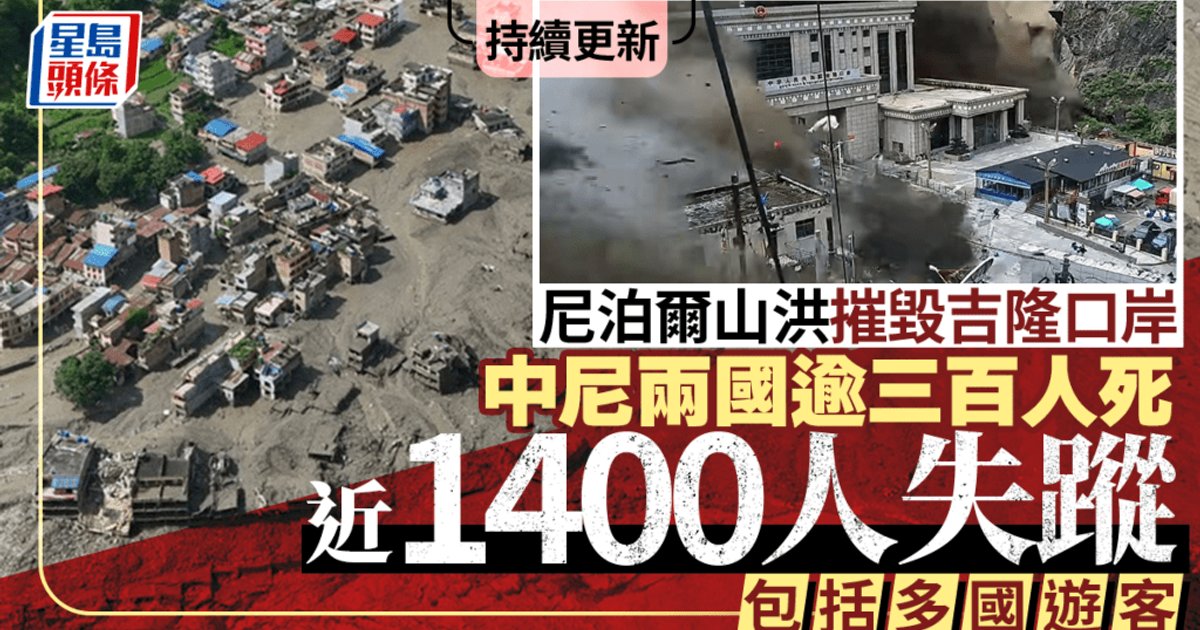
A catastrophic glacial avalanche struck the China-Nepal border on August 26, triggering massive mudslides that have killed over 360 people with potentially 2,000 more missing. The disaster, triggered by a massive ice block falling 1,200 meters and generating seismic force equivalent to a 5.2 magnitude earthquake, formed a deadly flood resembling liquid concrete that obliterated villages along the Bhote Koshi River. Chinese Premier Li Qiang arrived in Tibet's Gyirong County the following day to direct rescue operations as international relief efforts mobilize.
Key Points
- The massive ice block, approximately 2,000 feet wide, detached from a glacier at 17,000 feet elevation and crashed into the valley below, producing seismic shocks detected by US monitoring systems as equivalent to a 5.2 magnitude earthquake
- The resulting debris flow traveled at devastating speed, with Nepal disaster officials describing it as a "tsunami from the sky" that flattened villages along a 40 to 50 kilometer stretch
- Nepal police confirmed 389 deaths with 910 missing as of August 27, while Tibet authorities reported at least 3 deaths and 558 people unaccounted for in the Gyirong port area
- The Nepal Tourism Board reported 644 tourists missing, including 517 foreign nationals from approximately 30 countries and 127 Nepali tourists, with nearly 100 Chinese citizens among those unaccounted for
- A dammed lake formed upstream with approximately 2 million cubic meters of water, posing imminent breach risk with an additional 3 million cubic meters expected to accumulate within three days
Why It Matters
This disaster strikes a region still recovering from the devastating 2015 Nepal earthquake, with many communities never fully rebuilt. The catastrophe demonstrates the escalating threat of climate change-driven glacial instability in the Himalayas, affecting water systems and communities across South and Southeast Asia. International search and rescue operations face mounting challenges as the堰塞湖 dammed lake threatens to breach, potentially causing secondary flooding that could compound the humanitarian crisis.
This disaster strikes a region still recovering from the devastating 2015 Nepal earthquake, with many communities never fully rebuilt. The catastrophe demonstrates the escalating threat of climate change-driven glacial instability in the Himalayas, affecting water systems and communities across South and Southeast Asia. International search and rescue operations face mounting challenges as the堰塞湖 dammed lake threatens to breach, potentially causing secondary flooding that could compound the humanitarian crisis.