CUHK Completes Hong Kong's First Robot-Assisted Pelvic Fracture Surgery, Reducing Blood Loss by 90%
SingTao · 2 SOURCESabout 1 hour ago2 MIN
Summary
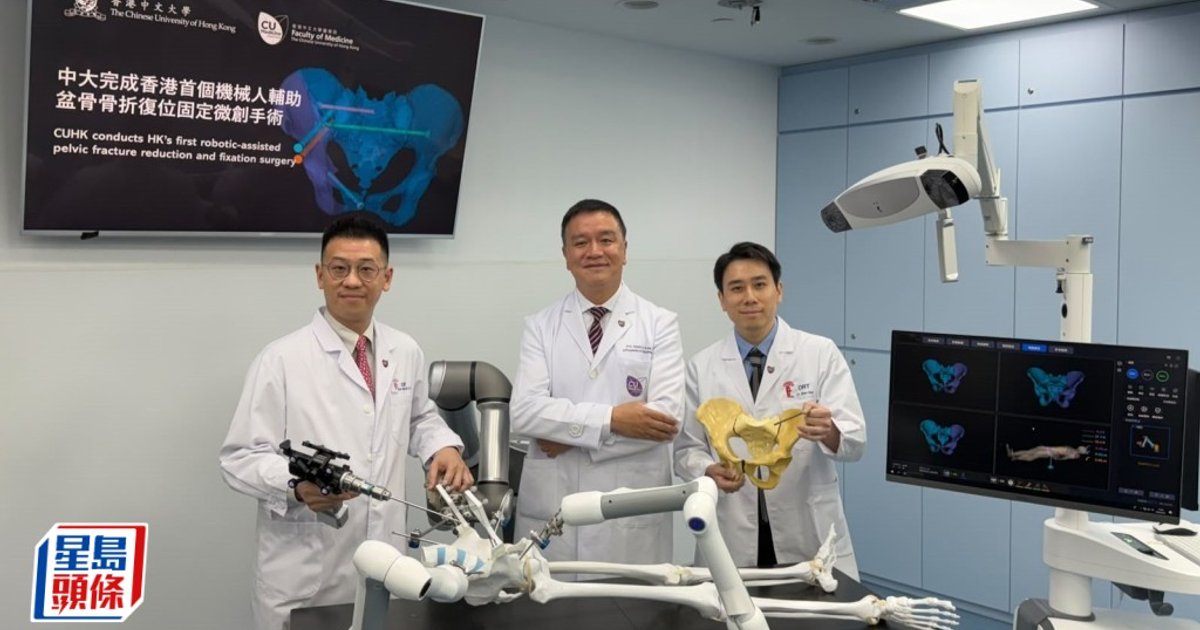
The Chinese University of Hong Kong Medical School achieved a medical milestone in June by completing Hong Kong's first robot-assisted pelvic fracture reduction minimally invasive surgery. The procedure, performed at Prince of Wales Hospital using Hong Kong's sole minimally invasive fracture reduction robotic system, resulted in blood loss of only 10-20 milliliters—representing a nearly 90 percent reduction compared to traditional open surgery. Three patients have undergone the groundbreaking procedure with favorable recovery outcomes, while the orthopedic team advances AI-powered planning tools for future applications.
Key Points
- CUHK's orthopedic team at Prince of Wales Hospital completed Hong Kong's first robot-assisted pelvic fracture reduction surgery in June
- Three patients underwent the procedure, with intraoperative blood loss of 10-20 milliliters versus approximately one liter in conventional surgery
- Surgical wounds were reduced from over 10 centimeters to less than 2 centimeters, significantly lowering pain and infection risks
- The robotic system utilizes real-time 3D navigation to guide fracture reduction and screw fixation with high precision
- Hong Kong records approximately 2,000 pelvic fragility fracture cases annually, with a 15 percent one-year mortality rate
- CUHK collaborated with Beijing Jishuitan Hospital and an innovation technology company to develop the system
- The robot has obtained National Medical Products Administration certification and is listed under Hong Kong's medical device regulation
- Two U.S. provisional patent applications have been filed for core AI technologies
Why It Matters
This breakthrough marks a paradigm shift in orthopedic trauma treatment, offering a safer and less invasive option for elderly patients who often cannot tolerate conventional open surgeries. The technology positions Hong Kong as a regional leader in medical robotics while demonstrating the transformative potential of cross-border collaboration between local research expertise and mainland clinical resources.
This breakthrough marks a paradigm shift in orthopedic trauma treatment, offering a safer and less invasive option for elderly patients who often cannot tolerate conventional open surgeries. The technology positions Hong Kong as a regional leader in medical robotics while demonstrating the transformative potential of cross-border collaboration between local research expertise and mainland clinical resources.