World Humanoid Robot Games: Chinese Robot Shatters Usain Bolt's 100m Record with 9.39-Second Sprint
Crhk · 2 SOURCESabout 1 hour ago2 MIN
Summary
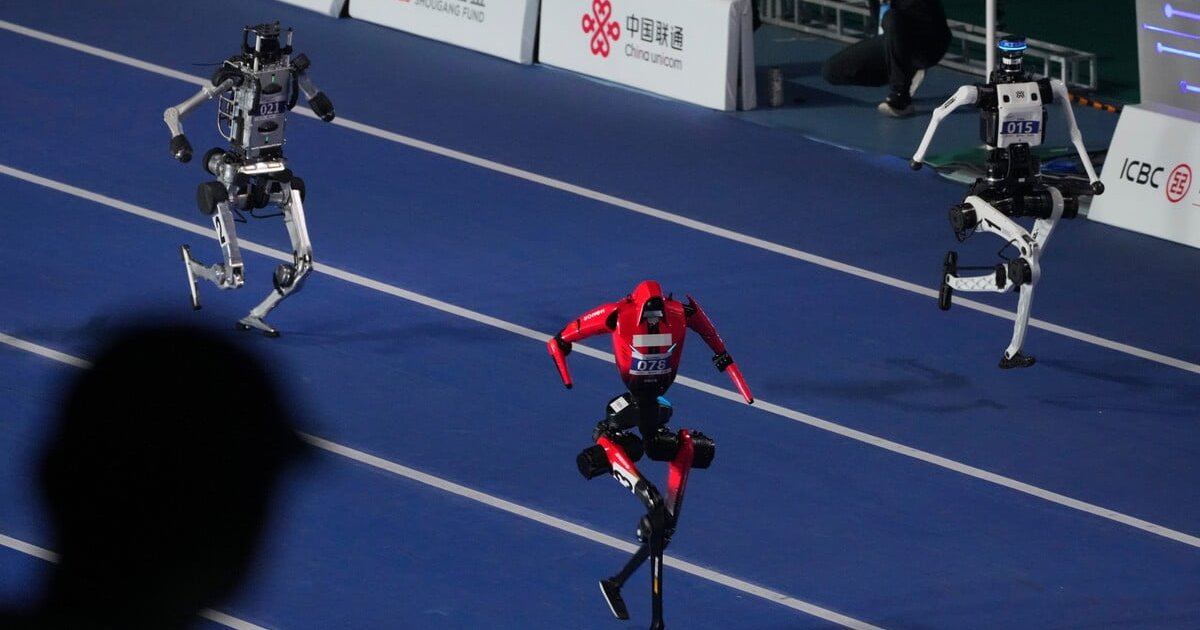
A Chinese humanoid robot has surpassed Usain Bolt's legendary 100-meter world record, completing the sprint in 9.39 seconds at the World Humanoid Robot Games in Beijing. The TianGong Ultra robot, developed by the Beijing Humanoid Robot Innovation Center, beat Bolt's 9.58-second human record by nearly two-tenths of a second during preliminary heats on Saturday. The historic achievement marks a significant milestone in humanoid robotics, with another robot from the same event also breaking the human world record. The second edition of the games, held at the National Speed Skating Hall, features 51 events and over 1,300 matches across five days.
Key Points
- The Tianzhuo team robot clocked 9.39 seconds in the large-class 100-meter preliminaries, beating Usain Bolt's 9.58-second human record
- The Fenghuo Shandian (Glory Lightning) team robot finished second with 9.47 seconds, also surpassing the human world record
- The TianGong Ultra also broke the standing high jump world record with a 2.88-meter clearance, demonstrating versatile athletic capabilities
- Beijing's Humanoid Robot Innovation Center achieved these results through joint optimization, lightweight wind-breaking design, and algorithm improvements
- The second edition of the games runs for five days from Saturday, featuring 51 events and 1,301 matches including football, table tennis, and tennis
Why It Matters
This record-breaking performance signals that humanoid robots are rapidly approaching—and in some metrics exceeding—human athletic capabilities, with implications for search-and-rescue operations, prosthetics development, and advanced manufacturing. The dramatic improvement from last year's 21.50-second champion time to this year's 9.39 seconds demonstrates the pace of robotics innovation, positioning China as a global leader in embodied AI technology that could reshape multiple industries .
This record-breaking performance signals that humanoid robots are rapidly approaching—and in some metrics exceeding—human athletic capabilities, with implications for search-and-rescue operations, prosthetics development, and advanced manufacturing. The dramatic improvement from last year's 21.50-second champion time to this year's 9.39 seconds demonstrates the pace of robotics innovation, positioning China as a global leader in embodied AI technology that could reshape multiple industries .