72% of Hong Kong Professionals Use AI Weekly, Double Global Average: HKUST Survey
AM730 · 2 SOURCESabout 1 hour ago3 MIN
Summary
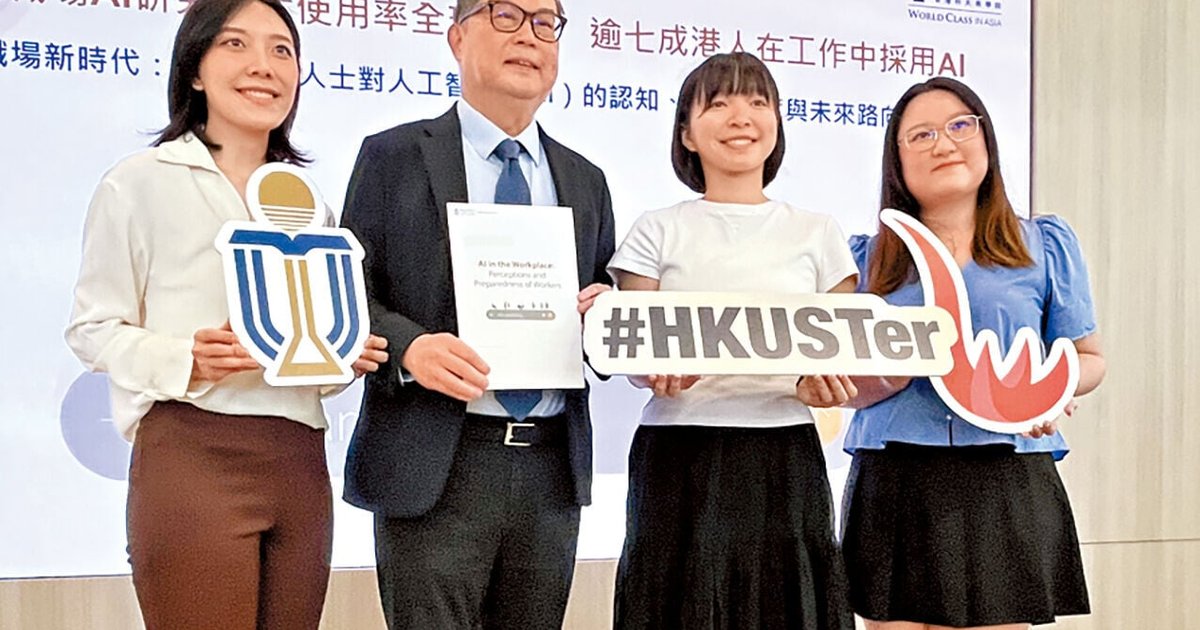
A comprehensive survey conducted by the Hong Kong University of Science and Technology (HKUST) has revealed that more than 70 percent of Hong Kong's working professionals regularly use artificial intelligence tools in their jobs, significantly outpacing global benchmarks. The study of 3,722 professionals found widespread AI adoption, particularly of generative AI tools such as ChatGPT and Gemini, but also exposed growing anxiety among junior staff about job security and skills devaluation. Researchers are calling on the government, businesses, and educational institutions to work together to bridge the AI capability gap across different segments of the workforce.
Key Points
- 72.7 percent of respondents use AI tools daily or weekly at work, compared with the global average of 31 percent cited in a 2025 KPMG study
- 81.7 percent of AI users employ generative AI tools, primarily for drafting documents, summarizing information, and supporting creative work
- More than 50 percent of junior-level employees worry AI could erode the value of their existing skills, while about 40 percent feel less secure in their jobs
- Nearly 60 percent of all respondents reported never receiving any AI training, and 73 percent are unaware of government AI-related policies
- Only about one-quarter regularly use more advanced AI applications such as data analytics, image or video generation tools, or agentic AI systems
- About 70 percent of senior managers say AI has increased their motivation to learn new skills, in contrast to the concerns held by junior staff
- Industries reporting the highest levels of job security concern include media and communications, financial services, and scientific and technical services
- Professor Tam Kar-Yan, HKUST's vice-president for administration, said the AI+ development strategy must ensure workers across all backgrounds can benefit from the transformation
Why It Matters
The survey results underscore both Hong Kong's rapid embrace of AI technology and the urgent need to address the digital divide within the workforce. With junior employees feeling vulnerable while senior managers remain enthusiastic, there's a risk that AI adoption could exacerbate rather than reduce inequality in the workplace. The findings also reveal a critical gap between government policy ambitions and workforce readiness, suggesting that successful implementation of Hong Kong's AI+ strategy will require substantial investment in training programmes and support for small and medium-sized enterprises .
The survey results underscore both Hong Kong's rapid embrace of AI technology and the urgent need to address the digital divide within the workforce. With junior employees feeling vulnerable while senior managers remain enthusiastic, there's a risk that AI adoption could exacerbate rather than reduce inequality in the workplace. The findings also reveal a critical gap between government policy ambitions and workforce readiness, suggesting that successful implementation of Hong Kong's AI+ strategy will require substantial investment in training programmes and support for small and medium-sized enterprises .