Government Outsourced Workers Denied Water During Heat Warnings, Guidelines Fail to Protect Labor Rights
HK01 · 1 SOURCESabout 1 hour ago2 MIN
Summary
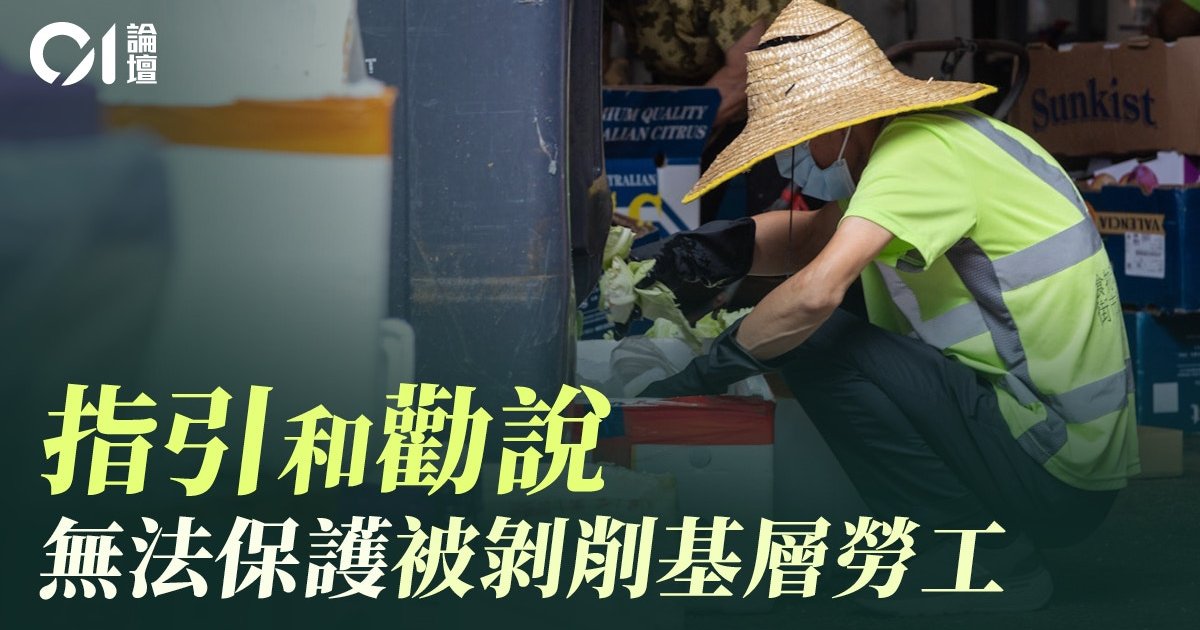
The Hong Kong Association of Senior Citizens has exposed how government outsourced contractors systematically violate heat prevention guidelines, with street cleaning workers denied water breaks and cooling equipment during extreme heat. Former Observatory Director Lam Chiu-ying criticized the Labour Department's Work Heat Stress Warning system for having thresholds too high to protect outdoor workers. The article urges the government to enact binding legislation with penalties, drawing comparisons with mandatory heat protection laws in Japan, Korea, and mainland China that hold employers legally accountable.
Key Points
- Street cleaning outsourced workers were ordered to work continuously without rest during yellow heat warnings, and were even refused access to drinking water in break rooms
- Worker rest facilities lack air conditioning, only equipped with solar-powered fans that fail during rainy weather, and some water dispensers contain mud
- Food and Environmental Hygiene Department outsourced workers were denied fans and ice sleeves because these items were not on supply lists and supervisors wished to avoid paperwork
- Japan mandates employer action when Wet Bulb Globe Temperature reaches 28 or temperature exceeds 31°C with work lasting over 1 hour, with violations punishable by imprisonment and fines
- Korea requires 20-minute breaks every 2 hours when apparent temperature hits 33°C, along with cool drinking water and shade facilities
- Guangdong province mandates complete stoppage of outdoor work at 39°C or above, and maximum 6 hours outdoor work at 37-39°C
- The 2006 "Wage Protection Movement" relying on employer self-regulation collapsed within two years, leading to the 2011 Minimum Wage Ordinance
Why It Matters
As Hong Kong records unprecedented high temperatures, the government's failure to enforce heat protection for its own outsourced workers undermines any credibility in regulating the private sector. This issue now presents a clear opportunity to revise the Employees' Compensation Ordinance to include heatstroke as a statutory occupational disease and upgrade current guidelines into binding law under the Occupational Safety and Health Ordinance, preventing further casualties among vulnerable outdoor workers .
As Hong Kong records unprecedented high temperatures, the government's failure to enforce heat protection for its own outsourced workers undermines any credibility in regulating the private sector. This issue now presents a clear opportunity to revise the Employees' Compensation Ordinance to include heatstroke as a statutory occupational disease and upgrade current guidelines into binding law under the Occupational Safety and Health Ordinance, preventing further casualties among vulnerable outdoor workers .